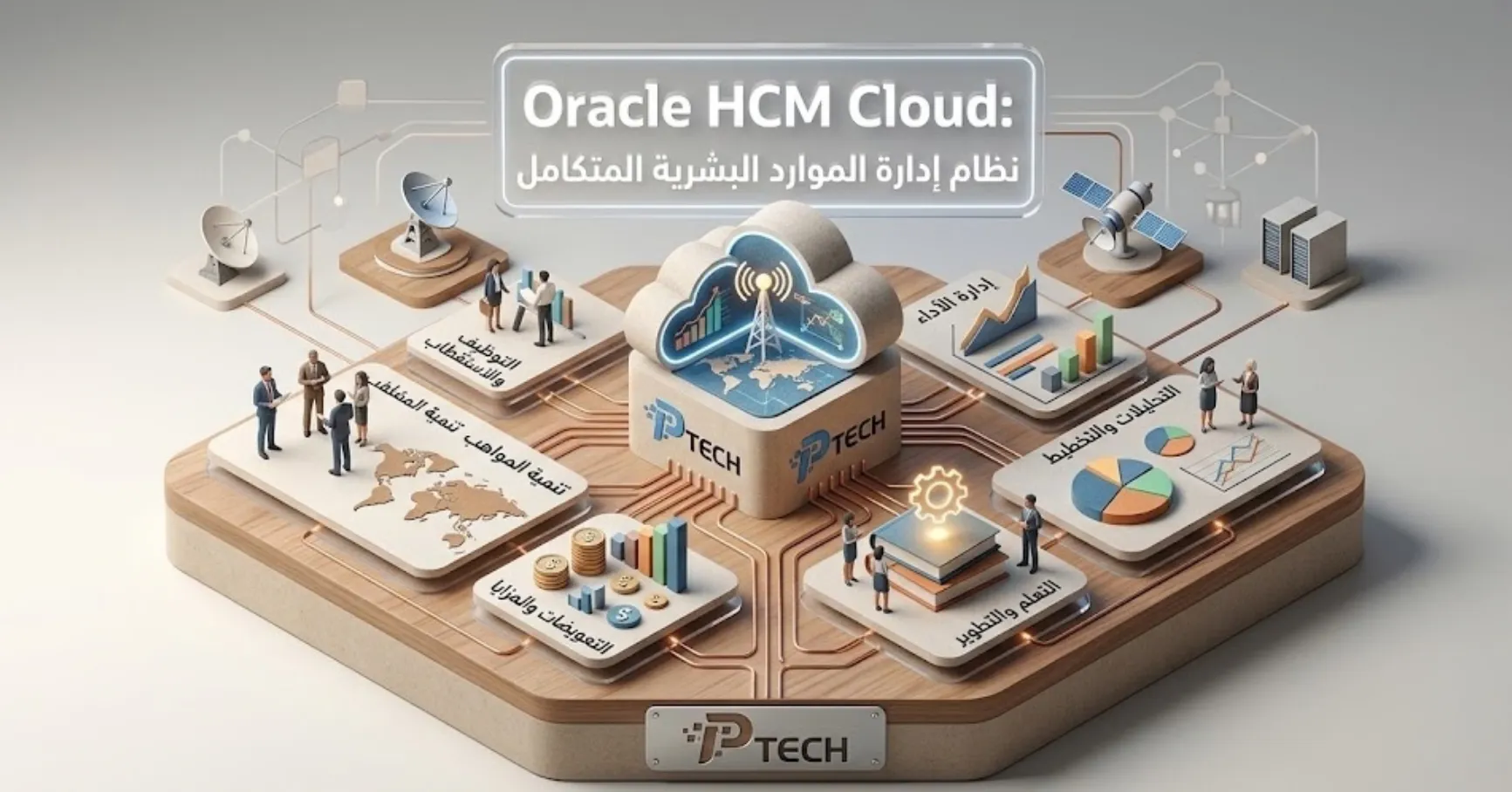
Oracle Fusion Cloud HCM is Oracle's comprehensive human capital management system, covering the complete employee lifecycle, from hiring to end of service, on a single unified platform: talent management, workforce management, payroll, and analytics. As we explained in our article [What Is Oracle ERP], this is a completely separate product from Oracle Fusion Cloud ERP (despite their close commercial ties), and it currently stands out for the biggest shift the entire HCM industry is witnessing: embedding hundreds of autonomous AI agents directly into everyday HR workflows. For companies operating in Saudi Arabia and the Gulf in particular, Oracle HCM offers deep local support for GOSI, Mudad (WPS), and Nitaqat Saudization requirements.
Core Modules of the System
Oracle HCM Cloud is built on four main interconnected pillars sharing the same data model:
Talent Management: recruiting, onboarding, learning, career development, performance management, compensation, and succession planning, all within a single integrated employee lifecycle.
Workforce Management: time, labor, and absence management, linked directly to payroll, financial, and personal data.
Payroll: a deeply configurable solution fully unified with the rest of the system, for processing globally compliant payroll regardless of industry, company size, or worker type.
HR Analytics: ready-made, customizable dashboards for monitoring workforce metrics and making decisions based on real data.
Talent Management in Detail
This area covers the full talent cycle: a recruiting experience that does not require candidates to create an account, a digital assistant that instantly answers their questions, native CRM tools for attracting targeted talent with personalized messages and landing pages, and AI-powered recommendations with self-service interview scheduling and data-driven offers. It also includes an internal Opportunity Marketplace that suggests suitable roles within the company to employees based on their actual skills, supporting internal career growth and talent retention, along with an AI-powered skills engine that identifies skill gaps and suggests appropriate development paths.
Payroll: A "Global-First" Approach
Oracle Payroll is built on an interesting technical philosophy: 80-90% of payroll processing functions are prebuilt and globally ready (shared best-practice rules), while only the remaining 10-20% is configured for each country's localization, using the same setup tools used to configure complex union requirements. The key practical benefit of this approach is that all these local configurations are "100% update-safe", meaning they automatically survive every new system update without breaking or needing to be reapplied.
Saudi and Gulf Localization: GOSI, Mudad, and Nitaqat Saudization
This section is the most important in practice for any company running actual payroll in the Kingdom. Oracle Payroll for Saudi Arabia provides cloud-native local support covering:
Social Insurance (GOSI)
Calculation of social insurance contributions for Saudi nationals in accordance with the regulations of the General Organization for Social Insurance, in addition to support for calculating contributions for GCC nationals working in Saudi Arabia at their specific rates. One noteworthy technical detail: the system automatically creates a GOSI details calculation card for each new employee upon hiring, based on their registered nationality, and handles special cases such as an employee's salary being insufficient to cover the full deduction of their GOSI share. In that case, the system automatically creates an "employer GOSI subsidy element" and tracks it as arrears that the employee can repay later in accordance with the Labor Law.
End-of-Service Benefits
An end-of-service benefit details calculation card is created automatically when any employee's service is terminated, instead of relying on a separate manual calculation.
Wage Protection System (Mudad - WPS)
Direct integration with the Mudad platform to ensure salary transfers and reports are fully and directly compliant through Saudi banking channels.
Nitaqat Saudization
Configuration of the Nitaqat classification by business activity sector, live dashboards showing actual Saudization ratios for HR managers and compliance teams, automatic alerts whenever a workforce change threatens the current Nitaqat classification, ready-made reports for the Ministry of Human Resources and Social Development, and integration with the Qiwa platform for managing employment contracts.
An important practical tip: According to implementation partners specializing in the Gulf region, setting up Nitaqat Saudization is considered the most operationally complex compliance requirement in the region, and it is the aspect most commonly left incomplete by implementation partners without real hands-on experience inside the Kingdom specifically.
The Biggest Shift in 2026: Agentic Applications for HR
In April 2026, Oracle launched what it calls "Fusion Agentic Applications for HR": autonomous AI agents embedded directly into talent management, workforce scheduling, payroll, and HR service delivery workflows. The key difference from a mere "AI assistant" is that these agents are designed to actually complete multi-step tasks (such as screening candidates, scheduling the workforce, and handling payroll exceptions), not just offer suggestions for a human to act on later.
According to Oracle's own data, the number of agents actively in use across the entire Fusion suite (including HCM) has exceeded 1,000, all available at no separate additional license cost within the base subscription. Among the most notable practical applications of these agents:
Manager Concierge workspace: brings compensation, performance, talent, and absence signals together in one place, prioritizes what needs immediate attention, and offers ready-made, policy-backed options and one-click decisions.
Workforce operations command center: coordinates scheduling, time, and absences, detects real-time risks, and simulates the cascading impact of any operational decision before it is made.
Interactive digital assistant: instantly answers employee questions about leave balances, policies, payroll information, and benefits, around the clock, without waiting for human intervention.
Who Actually Uses Oracle HCM?
According to reviews from real users, the system is widely used across multiple sectors: media, hospitals, information technology, real estate, financial institutions (banks and insurance), and government entities, especially to solve problems such as unifying the source of employee data, continuous performance evaluation, accelerating recruiting and onboarding, and providing a unified self-service portal for HR requests.
A Realistic Look at Implementation Timelines
According to actual data from implementation partners specializing in the Gulf region, the timeline varies by scope:
Core HR + payroll + absence management for a single entity: typically 4-6 months.
Adding talent management, recruiting, and workforce planning: the project extends to 7-10 months.
Multi-entity deployment (such as managing Saudi and UAE payroll at the same time): extends to 10-14 months, depending on payroll complexity and the scope of data migration.
Conclusion
Oracle HCM Cloud is not just a system for storing employee data; it is a unified platform that connects talent, workforce, payroll, and analytics on a single data model, with a very strong push in agentic AI that actually starts executing complete tasks rather than merely suggesting them. For companies operating in Saudi Arabia in particular, the depth of its local support for GOSI, Mudad, and Nitaqat Saudization requirements, built cloud-native rather than added later, makes it a serious option worth evaluating for any large organization managing a complex workforce in the Kingdom.
Frequently Asked Questions
Is Oracle HCM part of Oracle Fusion Cloud ERP? No, it is a separate product within Oracle's broader suite, although companies often purchase and integrate both products together to cover financial and HR operations on the same platform.
Does Oracle HCM calculate GOSI automatically based on the employee's nationality? Yes, the system automatically creates a dedicated GOSI calculation card for each new employee based on their registered nationality upon hiring, with support for different rates for GCC nationals working in Saudi Arabia.
Is Mudad (WPS) integration available natively in the system? Yes, through the dedicated Saudi localization within Oracle Payroll, ensuring salary transfers that are directly compliant with the Mudad platform.
What is new about the 2026 AI agents compared to traditional AI assistants? The key difference is that these agents are designed to actually complete full multi-step tasks (such as handling a payroll exception or scheduling the workforce), not just provide a recommendation for a human to carry out later.
How long does an Oracle HCM implementation take in Saudi Arabia? It depends on the scope: from 4-6 months for core functions (HR, payroll, and absence) for a single entity, up to 10-14 months for a multi-entity deployment across more than one Gulf country at the same time.