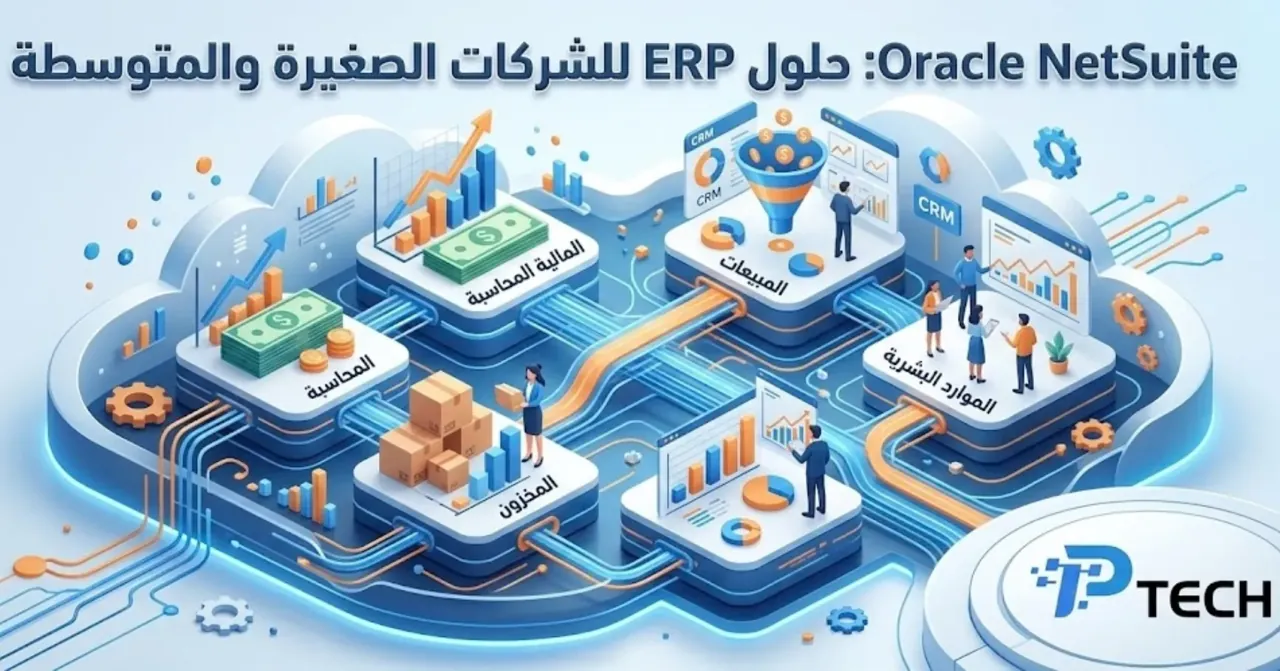
Oracle NetSuite is a complete cloud ERP system aimed primarily at small and mid-sized businesses (roughly $10 million to $500 million in revenue), while Oracle Fusion Cloud ERP (which we covered in a separate article) remains geared toward large enterprises. Both are Oracle cloud products, but they are built on two entirely different technology foundations and are not two editions of the same product. What makes NetSuite unique is that it is one of the world's first true cloud ERP systems, designed as multi-tenant SaaS from its founding.
A Quick Overview: The World's First True Cloud ERP
NetSuite was founded in 1998, at a time when the term "cloud computing" was hardly in use, and it was designed from the start as a genuine multi-tenant SaaS system, not a traditional system that was later "moved" to the cloud. Oracle acquired the company in 2016 in a deal worth more than $9 billion, adding for the first time a true cloud product aimed at the mid-market to its portfolio, alongside its larger enterprise product, Oracle Fusion.
Today (2026), NetSuite serves more than 37,000 customers in over 200 countries, is consistently ranked in the Leaders category in Gartner's evaluations of cloud core financial management systems, and is considered the most widely adopted cloud ERP in the mid-market segment specifically.
Technical Architecture: True SaaS with Two Major Updates a Year
Like Oracle Fusion, NetSuite runs on a fully multi-tenant SaaS model: all customers share the same codebase and infrastructure, rather than each having a separately hosted copy of traditional software. The key technical difference from Oracle Fusion: while Fusion receives mandatory updates every three months, NetSuite issues only two major releases per year, giving smaller technical teams relatively more flexibility in planning testing cycles.
An important practical technical advantage: customizations (built with SuiteScript and SuiteFlow) live in a layer completely isolated from the core code, so they automatically survive every update without the need for "re-implementation projects" after each new release, a common problem in other systems that are less mature in this respect.
Who Is NetSuite Right For?
The core target market: companies that have outgrown basic accounting tools (such as QuickBooks or scattered Excel spreadsheets) and need a truly unified system, typically with revenues between $10 million and about $500 million. That said, the system can actually scale to much larger companies without having to change platforms entirely. This "scalability without re-platforming" is one of NetSuite's greatest strengths: adding users, new legal entities, or additional modules is simply a configuration change, not a separate technical project.
When is NetSuite not the right choice? If your needs are still very simple (basic accounting only, with no real operational complexity), lighter accounting tools such as QuickBooks or Sage Intacct may be sufficient and simpler to start with.
Core Modules Included in the Base Platform
Every NetSuite subscription comes with a core set of capabilities as part of the base platform:
Financial management: general ledger, accounts payable and receivable, and fixed assets.
Order Management
Basic inventory
Basic Customer Relationship Management (CRM)
SuiteAnalytics dashboards and standard reports.
Add-On Modules as Needed
NetSuite follows a "build your base platform, then add what you actually need" model through separate add-on modules:
Advanced Financials: for more complex accounting requirements, multiple reporting standards, or business models based on recurring subscriptions.
Advanced Inventory and Warehouse Management (WMS): for companies with multiple warehouses or significant inventory complexity.
Manufacturing: for manufacturers that need bills of materials, work orders, and production planning.
SuiteCommerce: a native e-commerce solution (not a third-party add-on) that provides B2B and B2C storefronts fully integrated with inventory, orders, and accounting, without any external integration complexity.
SuitePeople HR: for managing human resources within the same ecosystem instead of a separate system.
OpenAir (Professional Services Automation, PSA): a standalone product acquired by NetSuite in 2008, with its own interface, designed for professional services and consulting firms to manage projects, resource allocation, and labor costing.
NetSuite OneWorld: the essential module for any company with multiple legal entities or operations in multiple countries. It provides real-time intercompany elimination, multi-currency support, and multi-book accounting across entities. It is absolutely necessary for any international operation, but it adds considerable complexity and cost to the subscription.
The SuiteSuccess Methodology: Rapid Implementation with Ready-Made Industry Templates
One of NetSuite's most notable practical advantages is the SuiteSuccess methodology: preconfigured, industry-specific implementation templates (manufacturing, software, retail, wholesale distribution, professional services, nonprofits, and more), built on best practices accumulated from thousands of previous deployments in the same industry. This approach cuts implementation time to around 3-4 months, compared with 4-6 months for a standard implementation, while complex implementations (multiple entities, large-scale data migration, custom integrations) can extend to 6-12 months.
An important practical tip: SuiteSuccess is excellent if your processes genuinely align with the ready-made industry template and you need a quick start with a limited scope. However, companies with complex integration needs, special third-party requirements, or deep non-standard customizations often find a specialist partner-led implementation more flexible than forcing a ready-made template onto their actual operations.
Customization Tools: From Simple Configuration to Full Development
NetSuite offers four tiers of customization tools:
SuiteBuilder: point-and-click configuration with no code.
SuiteFlow: visual workflow automation.
SuiteScript: full programmatic customization in JavaScript for complex business logic.
SuiteCloud: the complete developer platform for building fully extended applications on top of NetSuite.
AI: Built into the Core Experience
Starting with release 2026.1, Oracle has embedded AI capabilities directly into NetSuite's core modules rather than selling them as a separate add-on: anomaly detection, predictive forecasting, text generation, and AI-powered search, as well as intelligent transaction coding, all typically without separate additional licensing fees, within the edition and modules already subscribed to.
Global Reach
NetSuite supports more than 190 currencies and over 27 languages, with compliant statutory reporting for more than 190 countries, plus data hosting options across multiple geographic regions (North America, Europe, and Asia-Pacific) to meet data residency and local compliance requirements. This makes it a strong choice for any mid-sized company expanding internationally.
Who Actually Uses NetSuite?
The most common profiles of companies moving to NetSuite:
Companies moving away from manual management with QuickBooks or Excel that have reached an operational scale beyond what these tools can handle efficiently.
Companies with multiple branches or legal entities (locally or internationally) that need true financial consolidation.
Fast-growing companies that want a system that "grows with them" without having to change platforms entirely every few years.
E-commerce companies that want true native integration between their online store, inventory, and accounting without separate external connectors.
Conclusion
Oracle NetSuite is not a "mini" version of Oracle Fusion but an entirely different product in its technical origins and target audience: while Fusion serves large enterprises with enormous organizational complexity, NetSuite serves small and mid-sized businesses looking for a truly unified system to replace a scattered set of tools (standalone accounting + Excel spreadsheets + disparate tools), with a proven ability to grow without having to change platforms later. The SuiteSuccess methodology makes it a fast-start option for most companies with relatively standard requirements, while full flexibility through SuiteScript remains available for those who need deeper customization.
Frequently Asked Questions
Is Oracle NetSuite the same as Oracle Fusion Cloud ERP? No. Although both are Oracle cloud products, they are built on two entirely different technology foundations and target different audiences: NetSuite for small and mid-sized businesses, and Fusion for large enterprises.
How often is NetSuite updated? It issues only two major releases per year, compared with the mandatory quarterly updates in Oracle Fusion Cloud ERP.
What is the SuiteSuccess methodology? Preconfigured, industry-specific implementation templates that accelerate go-live to around 3-4 months, built on best practices accumulated from previous deployments in the same industry. It suits companies with relatively standard requirements and is less suitable for those needing deep customization.
Does NetSuite include online store management? Yes, through the SuiteCommerce module, a native e-commerce solution (not a third-party add-on) fully integrated with inventory, orders, and accounting.
When does a company specifically need the NetSuite OneWorld module? When it operates more than one legal entity or branch (locally or internationally) and needs real-time financial consolidation, intercompany elimination, and multi-currency, multi-book accounting.