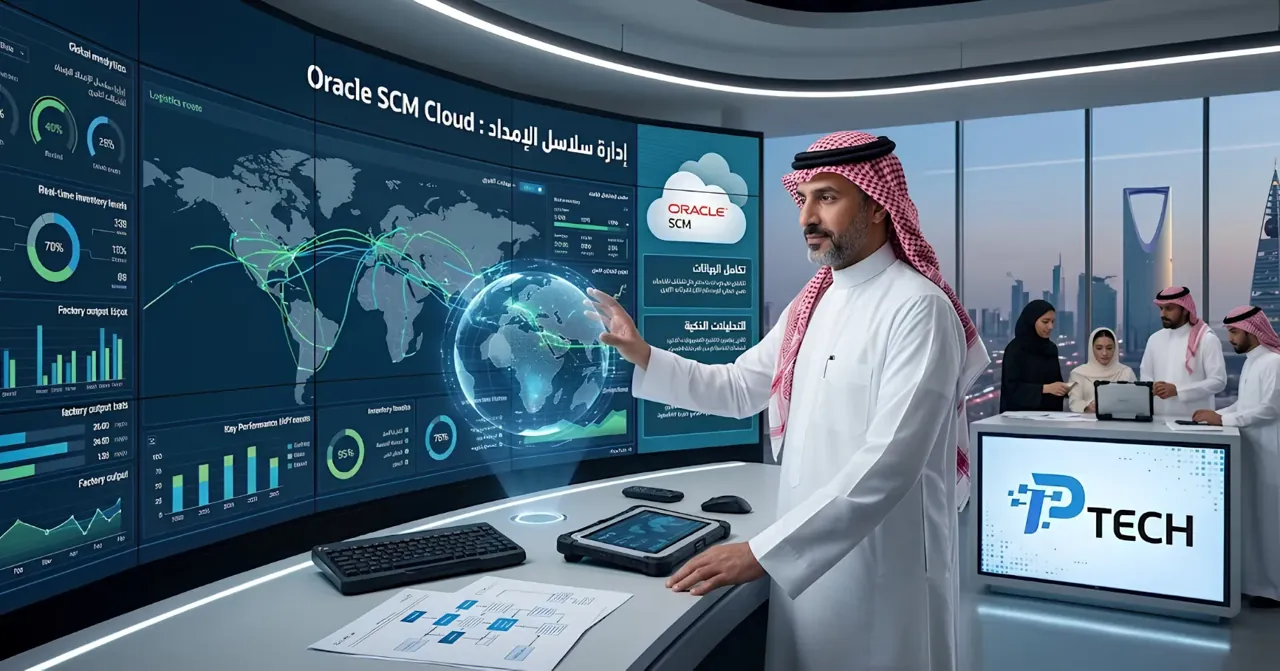
Quick answer: Oracle Fusion Cloud SCM is the supply chain management and manufacturing suite within the Oracle ecosystem. It covers the full cycle, from planning and demand forecasting, through procurement, manufacturing, and inventory, to logistics and product lifecycle management — all on a unified cloud platform with mandatory quarterly updates. Its latest additions: 29 ready-to-use AI agents that actually operate within day-to-day supply chain workflows at no separate additional cost.
Core Modules of the System
Oracle SCM Cloud covers eight main interconnected areas: demand management (forecasting and planning), supply planning, procurement, order management, manufacturing, inventory management, logistics, and product lifecycle management (PLM). Each module can be subscribed to separately, but the real value becomes much clearer when they are used together on the same database — just as with the other Oracle Fusion products we covered in previous articles.
Demand Management and Supply Planning
Oracle offers next-generation demand management that combines replenishment planning, dynamic market segmentation, new product introduction, and machine learning that helps planners turn diverse quantitative and qualitative signals into actionable insights. The system can automate time-phased replenishment across a multi-echelon network of stores and warehouses, and even supports specialized scenarios such as automated periodic automatic replenishment (PAR) specifically for clinical healthcare locations. Supply planning, meanwhile, determines the quantities of inventory, production capacity, and materials needed to meet demand, including drop shipping, back-to-back orders, and contract-manufactured products.
Smart, Flexible Manufacturing Scheduling
The system uses actual available resource data and live work orders from the manufacturing application to create realistic production schedules that account for material, capacity, and calendar constraints at the same time. These schedules can be visualized on an interactive Gantt chart, with drag-and-drop editing and fast "what-if" scenario simulations to resolve any issue before it actually occurs. The most important practical feature: dynamically repairing the schedule when any unexpected disruption occurs (a machine breakdown, labor shortage, material delay, or changing order priorities) without having to rebuild the entire schedule manually.
The Biggest Development in 2026: 29 New AI Agents
As we saw in the other Oracle articles in this series, the same pattern repeats strongly here: Oracle recently added 29 ready-to-use AI agents to its SCM and CX suites, embedded directly within business workflows, equipped with built-in security features, and available at no additional cost within the core Fusion applications. Among the most notable of these agents in practice:
Planning Cycle Agent: automates task coordination to improve the efficiency of recurring planning cycles.
Autonomous Sourcing Agent: prepares competitive bidding events, invites suppliers, and sends the necessary notifications automatically without direct human intervention.
Inventory Tasking Agent: reduces delays and improves warehouse productivity by finding open tasks, evaluating operators' skills, availability, and zones, and assigning tasks automatically.
Inventory Aging Advisor Agent: focuses specifically on reducing the carrying costs of slow-moving inventory.
Task Management Assistant: for logistics teams, it identifies and prioritizes at-risk orders to improve shipping reliability.
Purchase Order to Sales Order Agent: automatically extracts data from purchase orders in PDF format, creates and sends the corresponding sales orders, and summarizes any exceptions that require human review.
Product Lifecycle Management (PLM) and the Digital Thread
The PLM module unifies all product data — designs, materials, change history, and documents — in one place across the entire product lifecycle, from the initial idea to the end of production, through what Oracle calls the "Digital Thread," which unifies the supply chain and coordinates master product data across all departments. This accelerates time to market for new products and improves quality control across all manufacturing stages.
Logistics: Transportation, Global Trade, and Warehousing
This area covers three main components: Transportation Management to improve shipping reliability and reduce costs; Global Trade Management, including fast screening of restricted trade parties to ensure international customs and regulatory compliance; and Warehouse Management, equipped with the Wave Research Assistant, which summarizes the results of picking waves and highlights any urgent issue that needs immediate resolution.
Cloud Architecture: Quarterly Updates Like Other Fusion Products
Oracle SCM Cloud follows the same mandatory quarterly update model used across all Fusion products (as we explained in our article [What Is Oracle ERP]), with a clear schedule for each update wave (such as release 26A in February 2026, and release 26B going into production in mid-May 2026). This means new enhancements and AI features arrive automatically every three months, but it also requires testing discipline before each update, since some features are enabled automatically while others require optional configuration in advance — the same principle we discussed earlier regarding mandatory updates in Oracle Fusion ERP.
Who Is Oracle SCM Cloud Right For, and When Is an Alternative a Better Fit?
The system is especially suited to mid-sized and large companies with complex supply chains spanning multiple channels and locations. Independent analyst sources candidly acknowledge an important point worth considering: if you are a greenfield organization with no prior system, or dissatisfied with SAP's path to the cloud, Oracle SCM is actually the strongest alternative thanks to its fully cloud-native architecture (while SAP is still gradually managing the transition of its legacy customers). However, if your organization is already deeply embedded in an existing SAP ecosystem, the cost of switching may actually outweigh the benefits gained — the decision here depends less on which system is technically "stronger" and more on your actual existing technology stack, exactly as we discussed in detail in our article [Odoo vs SAP] regarding the same general principle.
A Quick Look at Implementation Time
Oracle SCM Cloud implementations tend to be relatively faster than those of traditional systems such as SAP (usually between 6 and 18 months depending on scope complexity), but it remains a major enterprise investment by nature, and not a quick project by any measure. The actual investment size depends heavily on the number of modules activated, the depth of integration with existing systems, and the complexity of the organization's actual supply chain.
Conclusion
Oracle SCM Cloud is a truly comprehensive suite for managing the entire supply chain — from demand forecasting to the product reaching the end customer — built entirely on a cloud-native architecture that receives real AI enhancements every three months at no separate additional cost. Its real value is most evident for large enterprises with complex supply chains that are starting from scratch or looking to move away from older, heavier systems, while any organization already deeply embedded in another existing system should carefully evaluate the cost of switching before making a decision.
Frequently Asked Questions
What is the difference between Oracle SCM Cloud and Oracle Fusion Cloud ERP? SCM is a suite specialized specifically in supply chain and manufacturing (planning, inventory, logistics), while Fusion ERP more broadly covers finance, procurement, and project management as well. You can subscribe to SCM on its own or together with the other Fusion pillars, depending on your actual needs.
How many AI agents are currently available in Oracle SCM? Oracle recently added 29 ready-to-use agents across SCM and CX combined, covering planning, procurement, manufacturing, maintenance, and logistics, all available at no separate additional license cost.
Is Oracle SCM better than SAP for supply chains? It depends on your current situation: if you are starting from scratch or dissatisfied with SAP's cloud path, Oracle is a strong alternative thanks to its fully cloud-native architecture. But if you are deeply embedded in an existing SAP ecosystem, the cost of switching may outweigh the benefits gained.
How long does an Oracle SCM Cloud implementation take? Usually between 6 and 18 months, depending on scope complexity and the number of modules — relatively faster than traditional systems, but still a major enterprise project and not a quick one by any measure.
Do small businesses need Oracle SCM Cloud? Usually not; the system is designed for mid-sized and large companies with complex supply chains, and its complexity may be more than necessary for small or relatively simple operations.